Showing posts with label Espresso. Show all posts

Tuesday, December 22, 2015

MINI HOLIDAY GIFT GUIDE: BIALETTI MOKA POT (AND TUTORIAL)


A few weeks ago, I thought to myself, "Should I work on a new holiday gift guide?" My answer was resounding "Nah" (as resounding as a "nah" can be), because I thought the 2014 holiday gift guide covered pretty much everything, especially with the suggestion of a labor-free staycation for mothers that I hope Mr Bee is considering.

Then I remembered there's a product so pretty, so Italian, so dear to me, and so reasonably priced that I have to recommend it to you for this holiday season. I'm talking about the caffettiera, or moka pot, the wonderful contraption that gives you a wonderful, strong coffee in minutes right from your stovetop. Coffee made with a moka pot is similar to espresso in its dosage (roughly) and instantaneous kick, and it is served in an espresso cup, sometimes with one or two teaspoons of sugar and/or a dash of milk. I believe every Italian household owns a few moka pots in various sizes, and drinks moka coffee first thing in the morning, after lunch, and with friends when they drop in for a visit.

There are many beautiful moka designs from different brands, but my favorite is the aluminum Bialetti pot patented in 1933 by Alfonso Bialetti and carrying the classic logo of the "little guy with a mustache" that you can see on the right. (Now that I think about it, they could have found a more inventive name for an Italian mascot.)

Here is everything you need to know about your moka pot once you decide to gift it or in case you become a lucky giftee. Read on.

HOW TO BUY 

You can find Bialetti pots online and at many Italian specialty stores. For a beginner, I'd recommend to start small with a 1- or 3-cup moka pot (around $25 for the latter) and a packet of replacement gaskets ($3.80 on Amazon). I'd also recommend enriching your gift with a bag of ground coffee, ideally from Lavazza or Illy moka or espresso ground (but once you get addicted, Café Bustelo at CVS purchased at dawn will also do). If you're dealing with a coffee lover, I would visit your local coffee roaster and ask for a dark or medium roast ground a little finer than drip coffee but a little coarser than espresso. And in case you're dealing with someone very special, you could gift a set of espresso cups, too.

FIRST DAY WITH YOUR MOKA POT

A moka pot needs to be thoroughly cleaned before it can produce proper coffee. Wash the three main parts (see diagram below) with warm water ONLY, then run the pot with only water for 3-4 times to remove any protective residue. I know you don't know how to use it yet, but I guess you'll have to read the entire post.


MAKE MOKA COFFEE!

1. Fill the bottom container with filtered water up to the internal valve.


2. Insert the funnel and fill it with ground coffee. You can make a small pyramid here, but in any case, NEVER press the coffee. Remove any ground coffee on the filter rim.


3. Screw on the top container. No need to apply a ton of strength here, but do a decent job so your coffee doesn't come out from the sides.


4. Place the moka on a low heat until the coffee emerges and fills the top container. If you're in another room, you'll be alerted by your moka's happy gurgling. DO NOT leave the coffee boiling any longer: It will taste burnt and awful, and you run the risk of ruining the gasket.


5. Pour your coffee, doctor with sugar and/or milk (or sambuca, or grappa) if this is what you're into, and drink.


MAINTENANCE

Maintenance for a moka pot is very easy. Wash the three main parts of the moka pot after each use with warm water, never with soap or detergent. You can use a stiff plastic brush to remove stubborn residue. Leave the parts to dry on a rack. Done!

Every six months, or whenever necessary, disassemble the moka and wash each part thoroughly making sure the filter is clean and the gasket is clean AND still soft. Run water through the moka chimney and make sure the valve is clean. If the small metal piece sticking out from the valve doesn't pop in when pressed, it means that there's coffee residue that needs to be cleaned. To remove limescale buildup, fill the bottom container with water and a little vinegar or lemon juice and let it boil for 10 minutes or more.

Replace gasket and filter as necessary, usually when they have become irreparably dirty, hard, or when coffee starts to sputter or comes out in only in part.

To read a poignant reflection on the diverging attitudes towards coffee for Italians and Americans, read Slow Food/Fast Coffee.


Wednesday, July 22, 2015

11 ESSENTIAL ITALIAN KITCHEN TOOLS


What are the essential tools that would make your kitchen truly Italian? After months and months of pondering, I'm ready to present you with my final list. It is based mostly on my personal experience as an expat, especially from the first year in Mr Bee's house, where I would search every drawer and cabinet for these little gems before calling my family in tears. Here they are, in all their indispensable glory.

1. MOKA POT

Moka pot


In Italian, la caffettiera. This beautiful, beautiful object appears in many formats in every single Italian household. The moka pot is the best and quickest way to have a strong coffee (just a little less concentrated than regular espresso) any time of the day, and especially in the morning. Just fill the bottom half with water, insert the portafilter, add espresso-grind coffee, and screw on the top half. Place on the stove, and you'll have your coffee in minutes. And, unlike an espresso machine, a moka pot is completely portable and requires minimal maintenance—just rinse in hot water after each use. In my opinion and that of many others, Bialetti makes the best.


2. GAS COOKER TRIVET

Gas cooker support for moka pot
Add caption


In Italian, la crocetta. This is a godsend if you're using a smaller moka pot on a gas cooker. It's a support to keep the moka pot in place on larger gas burners. It usually starts out much shinier than the one in the picture, which is by now well oxidated.


3. FINE CHEESE GRATER

Cheese server for Parmigiano


In Italian, la grattugia. If you need to grate Parmigiano or Pecorino for your pasta—and it's completely acceptable to do it right at the table before you eat—you need this. The small holes and the rounded surface allows you to grate the cheese in fine and soft ribbons, so that it starts melting immediately on your dish in all its salty and creamy goodness. The large-holed cheese grater that you use to shred cheese is not popular in Italy, where I believe it's only used for vegetables. I use this small grater from Ikea, but in Italy people use a larger one.


4. CHEESE SERVER


In Italian, la formaggiera. When you're not grating cheese straight on your plate, you can use a cheese server, great for formal dinners but definitely used everyday on the traditional Italian table. It needs to be filled with fresh Parmigiano, and people pass it along and sprinkle one or two teaspoons of cheese on their pasta. When I was younger, my grandparents would ask me to grate a small mountain of cheese on a plate and then pour it in the server in time for lunch. This one is from Alessi.


5. CRUMB SWEEPER


In Italian, il raccoglibriciole. In my opinion, nothing else encapsulates Italy more than this plastic brush designed to clean up your tablecloth from breadcrumbs after a meal. The popularity of this object means two things: that Italians like to eat at a table covered with proper tablecloth, and that they are going to have bread with whatever they're eating. After over ten years in the United States, I wonder whether Italians are keeping up with their social eating and bread dependency. I really hope so.


6. PASTA MACHINE

Pasta or pastry cutter

In Italian, la macchina per la pasta. I'm positive that Italians today do not make homemade pasta as often as their grandparents. However, this is a beautiful object that everybody who loves cooking should have. There are few things more satisfying than cranking your pasta machine on a floured table (and now that I have fresh pasta on my mind, I can't really think of any). Mine is a gorgeous red Imperia. Ask for one for you birthday.


7. PASTA CUTTER


In Italian, la rotella. If you own a pasta machine, then you cannot forgo the pasta cutter. It's perfect to cut ravioli, and of course you can also use it as pastry cutter for all your pies and quiches. Mine belonged to my maternal grandmother, and it's light, sturdy, and precise. I also love the sweet rattling sound it makes as it cuts through the dough. So satisfying.


8. DOUBLE-HANDLE MEZZALUNA


potato ricer

In Italian, mezzaluna ("half moon"). I was genuinely surprised that this was not a staple of American kitchens, too. It's perfect to chop herbs and nuts. Just rock it side to side, occasionally sweeping everything back to center for another round of chopping. You can object that a knife would be quicker, but that's true only if you have good knife skills (I don't). Plus, you'd be really missing out on all the fun, and I can't condone that.


9. RICER


In Italian, lo schiacciapatate. This is basically a gigantic garlic press for vegetables, and especially potatoes, that gives you the creamiest, fluffiest ribbons of potato you can ever dream of. Use a ricer to make puré, the (slightly) lighter and more elegant version of mashed potatoes, but also potato gnocchi, and my favorite fancy ice-cream creation: spaghetti ice cream.


10. CITRUS SQUEEZER


soup plate, use in Italy for the first course

In Italian, lo spremiagrumi. In winter, mothers all over Italy spend the best part of their day squeezing juicy Sicilian oranges for their little ones, because you know, vitamin C. And let me tell you, you really get to respect your mother when you see her exerting tremendous force on a tiny squeezer to obtain even the last drop of orange for your morning breakfast. Small and easy to clean, it's an Italian must-have.


11. SOUP PLATES


In Italian, i piatti fondi. Don't be fooled by their English name, the piatto fondo is not only for soups. Rather, it is the plate where the first course, or primo, is served. On a classic Italian table, you eat your pasta, soup, or rice dish on the soup plate, and then your second course on a dinner plate. I was dumbfounded when I came to the United States and discovered you only use dinner plates for pasta. The soup plate is the perfect vessel so that your primo feels neither too crudely exposed nor too infantilized. (Makes sense, right?) Luckily, my MIL gifted me a set of 6 soup plates so I can feel a little better when I get a little homesick and make myself a megaportion of ravioli.

Tuesday, July 14, 2015

I'M HOT AND YOU'RE COLD: CAFFÈ SHAKERATO


I need to voice one regret I have about my expat life, and that is that I moved from the horribly humid and mosquito-infested Venice summer right to the horribly humid and mosquito-infested DC summer. It was really a masterstroke for someone who, when exposed to summer heat, turns into a wheezing fuchsia toad covered in welts. And yet here I am, surviving in DC in July (barely but surely) thanks to my highly refined immobility skills and Arctic A/C. What also helps? Caffè shakerato, or Italian ice coffee.

I don't need to convince anybody of the worthiness of ice drinks, and ice coffee in particular. And yet, many times I've felt like regular ice coffee doesn't really cut it, mostly because the melting ice tends to water down the coffee flavor and its ability to wake me up from my heat-induced stupor. The only answer is the Italian variation of ice coffee that is caffè shakerato. This is basically a long shot of espresso, sugared to taste, and shaken in a cocktail shaker so that it produces a thick and lovely foam on top. In Italy caffè shakerato is served everywhere, usually in a Martini glass, and it can really be a glorious break for your summer afternoon.

That's my husband's hand. I don't know why I get so paranoid about you thinking it's mine.

However, if your coffee bar doesn't serve caffè shakerato and if you don't care about formalities, you can make one at home very easily and drink it whenever you prefer. What I do is add a little bit of sugar to my coffee and shake it in a canning jar with three ice cubes. It's ready in 15 seconds with minimal amount of physical effort (which is really all I can afford in 99% humidity), and cools me down and wakes me up in no time. I almost (almost) feel like a functional human being when I drink one. Give it a shot.
CAVEAT! To make caffè shakerato, you can only use espresso or coffee made with a moka pot. If you don't have an espresso machine, I really suggest you get hold of a moka. It's fairly inexpensive, it's quick and easy to use, and it's one of the most beautiful objects you can own. Until I write a post about it, learn how to use it here.

CAFFÈ SHAKERATO 

Makes 2 coffees

Equipment needed: espresso machine or moka pot, one-pint canning jar

2-3 shots of espresso, or the coffee brewed in a 2-Serving moka pot
sugar to taste
5 ice cubes 


  • Brew the coffee, with a little bit more water than usual.
  • Add sugar to taste and stir well until dissolved.
  • Place the ice into the canning jar, and pour in the coffee.
  • Close the jar tightly, and shake vigorously for no more than 15 seconds. 
  • Pour the coffee into two glasses, holding any leftover ice in the jar with a spoon, letting the coffee foam pour over your coffee in all its luscious creaminess.

Friday, July 10, 2015

SLOW FOOD/FAST COFFEE

Last year, my sister visited from Italy, and I took her to a beloved neighborhood coffee place. We placed our order for two espressos, and then I stood back to analyze the various stages of shock she was bound to experience. The reason? The espresso making took FOREVER. My sister stared in increasing disbelief as the barista took all the time in the world to go through the 7 Steps of modern American artisanal espresso-making:
  1. Pour ground coffee into the handle in atomic increments.
  2. Press the coffee down with complete concentration in carefully-applied 30-lb thrusts.
  3. Polish the border of the handle until it shines, completely speckless.
  4. Let the coffee drip into the cup with monastic patience.
  5. Examine the espresso closely for possible flaws that would nullify the process.
  6. Send a silent prayer to the coffee gods to ensure future blessing.
  7. Place the finished espressos on the counter for the costumer to finally enjoy. (Avoid eye contact.)
You know what it's like: It took at least 10 minutes from start to finish. My sister looked at me, her brown, life-filled Italian eyes wide open, and said, "We need to open our espresso bar. We'll be millionaires!"

See, espresso in Italy (we call it coffee) is actually a very quick experience. Even in the nicest torrefazioni (cafes where coffee is roasted and served), it might take a minute at most for a perfect espresso to appear in front of you after your order. It's not only that Italians barista are quick, it's that they have to be. We Italians are physically and culturally addicted to coffee and to its almost instantaneous kick, so much that we don't even care about sitting down at a coffee bar. We need our espresso, and we need it NOW. That's why at home we use the little stovetop moka, because it produces a concentrated coffee in a matter of minutes.

Anyway, my sister thought Americans would love to have their coffee just as fast. She thought, arent' they addicted, too? Well, as much as her fantasy of opening an espresso bar appealed to me, I knew it would never work in America. Nobody cares about a fast espresso here. Instead, a carefully-poured espresso is popular because it reminds American of the artistry and tradition of coffee. An express espresso would not have the same charm.

So I started thinking, and I realized there is a major difference between American and Italian approach to food and coffee that I summarized in this handy infographic:


Italians will happily wait 20 to 30 minutes for the appetizers to show up and would never dream of having lunch in the car, but need their espresso right away, preferably standing up, and five minutes later they're already on their way. In Italy, a barista is as swift and invisible as a ghostly apparition, seen only with the corner of your eye.

Who is right, then? Well, Italians, of course. We're always right on food. But I will concede that slow coffee has its charms. I very much appreciate the dedication that American baristas are giving to our home staple, and I am definitely thankful to them for taking espresso seriously enough to transform it from a bitter soup to a creamy deliciousness that is often just as good as the original. And as soon as you get addicted as Italians are, I know you'll learn to make it quick. See you on the other side.

Wednesday, February 4, 2015

COFFEE LOVE

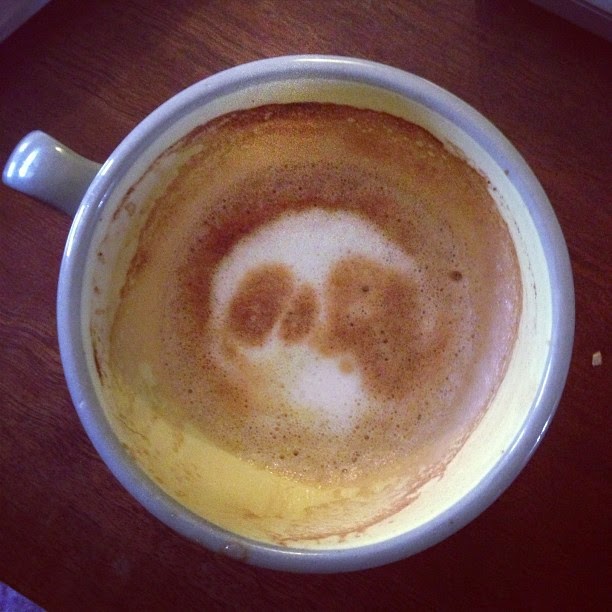
Espresso cup where the froth looks like a skull
What is Mr Bee's espresso trying to tell me?
Sorry people, I've been busy with kids and work recently, and my Hotpoint stove died for good last week, so I have neither blog-post ideas nor Instagrammable food (unless you really want to see the calzone I ordered yesterday for delivery). So I've taken an old post from Italian Dead Chef, vintage 2006, about opening your heart to the person you love. Spoiler alert: DON'T.

I moved in with Mr Bee almost three years ago. When I first I came over, on a sweltering hot June day, I brought only one piece of luggage for three months. In that bag, I carried the minimum necessary amount of clothing for a Washington summer and a immigrant-family-size stockpile of Italian food such as Gragnano pasta, fresh ravioli, dried porcini mushroom, hunks of Parmigiano Reggiano (crustless, from the heart of the wheel), frozen home-made pesto, and coffee. In those three months, I committed to preparing daily and irresistible Italian meals, flaunting a continental nonchalance that Mr Bee could simply not resist.

But my little secrets and cute cooking tips did not last long. My American student was more curious and eager than I hoped, and within a year he had unveiled my bottomless ignorance in the kitchen. Who betrayed me? Coffee.


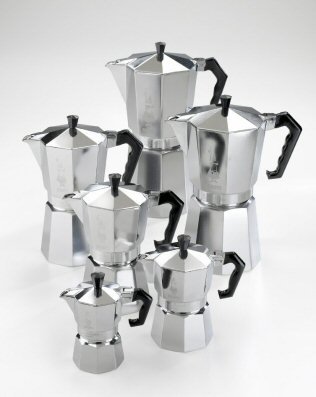
The Bialetti family
When I arrived in DC with a Bialetti stovetop coffee maker and four packages of Lavazza Qualità Oro ground coffee beans, it was easy to seduce Mr Bee, who had almost never had a coffee in his life. Unfortunately, the initial dose was so addictive that Mr Bee soon developed an obsession for espresso, a subject I know... well... NOTHING ABOUT. Sure, I drink espresso in Italy all the time, but ask me about how to do it, and I will deftly change subject.

Since Mr Bee was introduced to Italian coffee,  his love for the Arabica bean has exploded in the following purchases: a vintage Gaggia espresso machine, a burr coffee grinder (no blades, are you crazy?), a 4-lbs package of original whole coffee beans from the famed coffee shop Sant'Eustachio in Rome, two heavy-duty tampers, two metal pitchers for frothing milk, a knock box, set of two-ounces thick porcelain espresso cups, and a barista manual written by a visionary alchemist from Seattle who is considered the true prophet of espresso in America. Needless to say, we put my Bialetti aside and switched to fabulous morning espresso.

All this makes me really happy, of course, because the espresso I now drink at home is very high-quality and comes in a pre-heated cup. The problem arises when, in a hurry early in the morning, I dare make my own.


At whatever ungodly hour of the morning I decide to have my espresso, Mr Bee appears in the exact moment I try in vain to press the coffee into the handle, and balks in terror. The reason? I'm not pressing hard enough. Personally, at 6 in the morning (and also at 7, 8, 9, and 10), I can't even make a fist, so you can very well imagine how hard it is for me to apply 40 lbs of pressure to the portafilter. When the coffee finally drips inside my cup, too quick or too liquid, Mr Bee shakes his head with the most heartbreaking sadness: if I had to waste the good coffee imported from Italy, could I at least ask him to prepare it? He's almost about to leave me alone, when he notices that the crema on my coffee is too pale, a sure sign that the water was not hot enough, or that the coffee had not been pressed uniformly or vigorously enough. God helps us all when I add my teaspoon of sugar! Sugar in my coffee is the epitaph of my coffee disaster.

So I can't help thinking back about those days, a long time ago, when I would smile at Mr Bee and show him how much coffee you put inside you stovetop coffee pot, and how you can make a quick crema by whisking a little coffee and sugar together with a teaspoon. His eyes were wide open with wonder, and I felt like proud and generous ambassador of a wonderful heritage. Now that Mr Bee has unveiled my cheap kitchen tricks and my botched, sub-par Italian coffee, I wish I had kept a few tricks for myself. Damn Italian hospitality.


Tuesday, April 22, 2014

EXPERIENCE THE CLASS SYSTEM IN A CAT CAFÉ

You might have heard of a pop-up cat café in opening on Thursday in New York. Cat cafes are popular in Japan (although I've read they originated in Taiwan), and on my 2010 Tokyo adventure, I made sure I visited two of them in the company of Anna (from the excellent Tamago Craft). So, dear American cat people: I know you're drooling at the idea of sipping a delicious gourmet coffee while petting kittens and relaxing to a symphonic harmony of purring. What you're going to get instead, it's a bitter lesson in class system. And let me add this, it's about time!

Notice the patrons pretending they are not crushed by the cats ignoring them.
(www.swide.com)

If the New York cat café is anything like the ones in Tokyo, you will be spending a good fee for entrance, drink watered-down and overpriced cappuccino in fancy but not-too-fancy china, and you'll sit there in excited discomfort for your allowed time (many places have a hourly fee) while painfully beautiful pedigree cats avoid you like the plague. In the best of cases, these cats will just sit in their carpeted scratching-post lofts with their back turned to you. In the worst of cases, you will try to sit next to them only to see them leave immediately for the aforementioned carpeted scratching-post lofts. These cats won't acknowledge your calls, won't purr, won't make eye contact: The only thing they'll make very clear is that they think you're low-class scum.

At times an eccentric cat might approach you for a quick petting session, but it will hurry back to its friends immediately afterwards to show you that was just an ironic social experiment. It's the cat version of the purely aristocratic thrill of occasionally mixing with the peasants.

For you American patrons, visiting a cat café is going to feel like winning a lottery ticket to an archduke's ball, but without any introductory niceties. At this ball, nobody is going to dance with you, nobody is going to socialize with you, nobody is even going to give you the slightest impression they want to see you again. And everybody will look a million times better than you ever will (and they know it).

Thanks to these cat cafes, America can finally experience what other countries around the world are dominated by: an immovable class system, the self-hatred of the lower classes, the awesome power of apparently helpless beings, albeit beautiful, heartbreakingly beautiful beings.

Friday, November 22, 2013

DOLCI GELATI AND THE ÜBERCROISSANT

I'm sure most of you DC people are familiar with Dolci Gelati and their delicious pints of Italian gelato sold at retailers like Whole Paycheck and Yes! Organic Robbery. When I heard they were opening a café in Takoma Park, MD, I was more than thrilled to get a fresh scoop for myself and initiate my son to the joy of gelato before he tasted ice-cream. It's a parenting theory I'm developing called culinary imprinting.


Almond croissant, I worship Thee!
When I first entered the Cafe, I was happy to see an array of croissants on display together with the gelati. Since croissants are one of my favorite things in life, I immediately ordered a scoop of hazelnut gelato and an almond croissant. What can I say? I loved the first one, but I was completely blown away by the second. The croissant was super-buttery, perfectly flaky, but also had a surprising crunch that reminded me of the Neapolitan sfogliatella, the pastry of the Gods. The almond filling was also a surprise: It wasn't the usual almond paste (not that I have anything against it), but it was an luscious, almond-flavored soft custard. 

Just like that, I realizing I was biting into the unexpected and wonderfully humbling evolution of the old croissant into the Nietzschean Übercroissant. (What about the cronut? Well, as the name clearly indicates, it's a step backwards: It's the Cro-Magnon of croissants.)


Nothing plain about this plain croissant.

I immediately asked the teenage cashier where those beautiful croissant came from, and she laconically replied they were made daily for Dolci Gelati by "this guy." I didn't press her further. What I learned from subsequent visits and questioning, is that the croissants are available only on weekends, and that they come in different flavors: plain, almond, chocolate, and piña colada. I tried them all, and they're all great, especially the chocolate ones, whose filling is as soft and pillowy as in the almond croissant.

On Dolci Gelati's website, I then learned that the chef, Gianluigi Dellaccio, trained at the century-old Neapolitan pastryshop Scaturchio, which not only serves one of the best espresso in the world, but PERFECT sfogliatelle as well, which made me wonder if this experience gave the croissants at Dolci Gelati their unique crunch. And by the way, I was lucky enough to have breakfast at Scaturchio every day on a short trip to Naples a few years ago, and I can say every day away from that counter has been, literally, hell on earth. (OK, maybe not literally.)

So, these days my weekend outings in Takoma Park include a gelato, a croissant, and a macchiato. Because the coffee at Dolci Gelati is pretty great, too, in case you were wondering.

Yes, I have three pics. Macchiato and two mini croissants.

Thursday, October 24, 2013

GUEST POST: The Café Files No.1

By Alec Bourgeois

A perfect espresso has many things in common with a perfect roux, not the least of which is the dark nutty brown color that defines success in each. My father, a New Orleans native, has a gentle way of telling you that your roux sucks. When you ask his opinion of your raw undercooked roux he reassuringly tells you that you've created a "nice blond roux" -- which makes it sound like it's a "thing". It's not a thing. A blond roux means it's raw and undercooked. The same goes for espresso, if your espresso is anything other than the deep brown hue of a hazelnut you probably shouldn't serve it.

THIS is an espresso.
THIS is a roux.